



Infinite Horizons: April 15th “Going Beyond Passive Ocean Color Remote-sensed Observations: Use of lidar for Monitoring the Vertical Structure of the Ocean Color”
Speaker: Prof. Cédric Jamet (University of the Littoral Opal Coast, France)
4pm, Beijing time
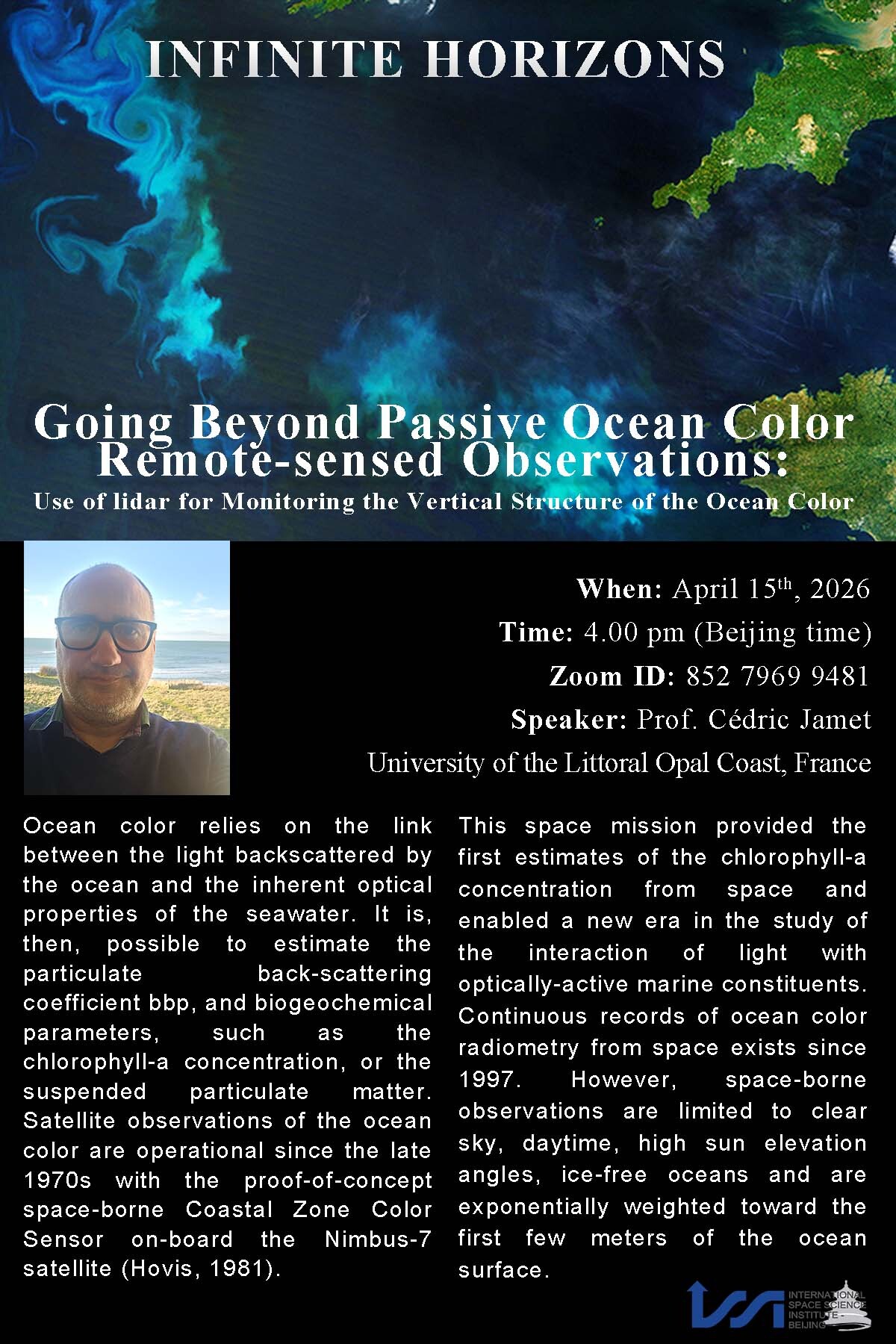
We have the pleasure to host the next Infinite Horizons' seminar on April 15th, 2026. Our host will be Prof. Cédric Jamet from the University of the Littoral Opal Coast will talk about Going Beyond Passive Ocean Color Remote-sensed Observations: Use of lidar for Monitoring the Vertical Structure of the Ocean Color.
Seminar's abstract:
Ocean color relies on the link between the light backscattered by the ocean and the inherent optical properties of the seawater. It is, then, possible to estimate the particulate back-scattering coefficient bbp, and biogeochemical parameters, such as the chlorophyll-a concentration, or the suspended particulate matter. Satellite observations of the ocean color are operational since the late 1970s with the proof-of-concept space-borne Coastal Zone Color Sensor on-board the Nimbus-7 satellite (Hovis, 1981). This space mission provided the first estimates of the chlorophyll-a concentration from space and enabled a new era in the study of the interaction of light with optically-active marine constituents. Continuous records of ocean color radiometry from space exists since 1997. However, space-borne observations are limited to clear sky, daytime, high sun elevation angles, ice-free oceans and are exponentially weighted toward the first few meters of the ocean surface. Moreover, the processing of the ocean color images requires the knowledge (or assumed relationships) of the atmospheric components (gases, air molecules and aerosols), which contributes to around ninety percent of the total signal measured by the remote sensor in the open ocea. Finally, passive space-borne ocean color measurements are unable to resolve phytoplankton vertical structure, and this can be a primary source of error in global phytoplankton biomass and net primary production estimates. This means that it becomes highly necessary to use complementary remote sensing techniques for getting a 3-D view of the ocean color. Among existing remote sensing techniques, lidar (Light Detection And Ranging, an active remote sensing, as it produces its own signal) is particularly promising for ocean applications as it can overcome some limitations of passive remote-sensed observations. During this seminar, the fundamentals of lidar will be presented, followed by examples of applications. Finally, a roadmap will showcase the limitations and perspectives.
Zoom ID: 852 7969 9481
(Our Infinite Horizons seminars are usually host on the third Wednesday of the month)
About the speaker:
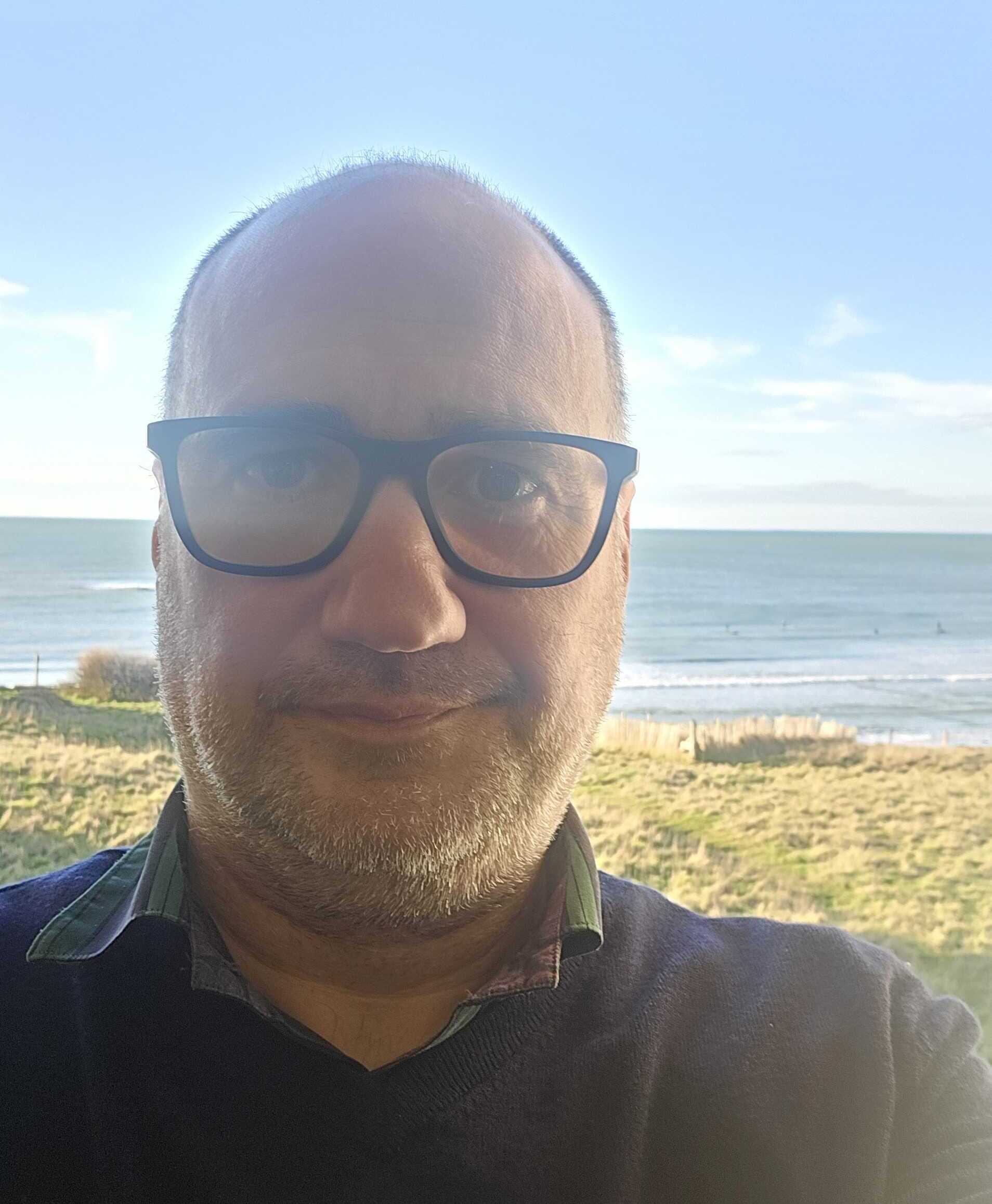
Prof. Cédric Jamet is a Professor at the University of the Littoral Opal Coast, in Wimereux. He received a PhD in remote sensing from the Université Pierre and Marie Curie (Paris) in 2004 and a Habilitation à Diriger des Recherches (HDR) from the Université du Littoral-Côte d'Opale in 2017. He is currently the deputy director of LOG.
His research field includes passive and active remote sensing of ocean colour, atmospheric correction algorithms, ocean colour algorithms (use of machine learning for the estimation of apparent and inherent optical properties), spatial/temporal variations of space-derived products at regional and basin scales. His current main focus is the use of lidar for monitoring the vertical structure of the ocean color in the upper ocean.
He was the chair of an IOCCG working group on atmospheric correction over coastal waters and the chair of an International Team at the International Space Sciences Institute on the evaluation of space-borne oceanic lidar products and is currently the chair of an IOCCG working group on lidar for ocean color applications. He has been PI of 4 projects funded by CNES and co-PI of 4 projects funded by ESA and EUMETSAT on passive and active remote sensing of ocean color. Lately, he was PI of a project funded by CNES on the study of the feasibility of lidar for ocean applications and co-PI of an ESA project on the study of the capability of the ESA ALADIN UV lidar to estimate ocean color products. He is currently the PI of an ESA-funded project on a phase-0 for a oceanic lidar space mission. He is the author of 63 publications, one book and three chapters of books.